

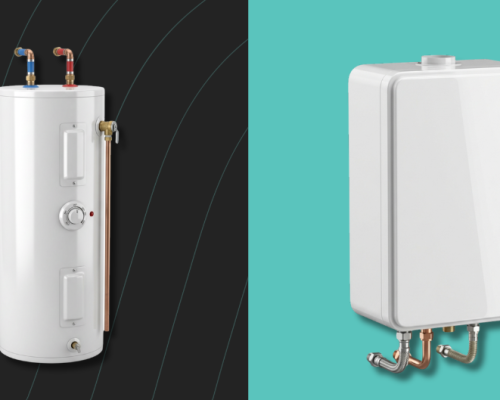
Choosing a new water heater is an important decision. Your system affects your daily comfort, hot water availability, energy use, and monthly utility costs. When replacement time comes, one of the biggest decisions is whether to choose a traditional tank or a tankless system.
The tank vs. tankless water heater debate doesn’t have one right answer. Traditional tank systems typically have lower upfront costs, while tankless water heaters offer on-demand hot water, space savings, and potentially greater energy efficiency.
At Flow Pro Plumbing and Drain Cleaning, we help homeowners compare their options and choose the right system. Here’s what to consider before scheduling your next water heater installation.
A traditional water heater stores heated water in an insulated tank, with many residential models holding approximately 40 to 80 gallons. The system maintains the water at a set temperature so it’s ready when you need it.
Tank water heaters remain popular because they’re reliable, familiar, and generally less expensive to purchase and install. However, because the system continually keeps stored water hot, some energy can be lost through standby heat loss.
Rather than storing hot water, a tankless water heater heats water as you need it. When you turn on a hot water fixture, water passes through the unit, where it’s heated before reaching your faucet or appliance.
This on-demand operation reduces the need to continuously heat stored water and can provide a continuous supply of hot water within the unit’s capacity.
Proper tankless water heater installation is essential because the system needs to be correctly sized for your home’s hot water demand.
Traditional tank water heaters generally cost less to purchase and install, particularly when replacing an existing tank with a similar model.
Tankless systems usually require a larger upfront investment. Converting from tank to tankless may require modifications to gas lines, electrical service, venting, or plumbing.
If keeping initial costs down is your priority, a traditional tank may make more sense. If you’re planning to stay in your home long-term and value efficiency and longevity, the additional investment in tankless may be worthwhile.
Energy efficiency is one of the main reasons homeowners consider tankless systems.
Traditional water heaters maintain a tank of hot water even when it isn’t being used. Tankless systems heat water only when there’s demand, helping reduce standby energy loss.
Actual energy savings depend on household usage, fuel type, equipment efficiency, installation, and maintenance. It’s important to compare the efficiency ratings of specific models rather than assuming every tankless system will provide the same savings.
Lifespan is another important factor in the tank vs. tankless water heater comparison.
Traditional tank water heaters commonly last around 8 to 12 years, depending on water quality, usage, installation, and maintenance.
Tankless systems can often last 15 to 20 years or longer with proper care. Their longer potential lifespan may help offset some of the higher initial installation cost.
Regardless of the system you choose, regular maintenance can help protect your investment and extend its useful life.
Both types require routine water heater maintenance.
Traditional tanks can develop sediment buildup, which may reduce efficiency and contribute to wear. Maintenance may include flushing the tank, inspecting for leaks or corrosion, and checking important safety components.
Tankless systems can develop mineral deposits inside the heat exchanger. Periodic flushing or descaling may be necessary to maintain performance, particularly in homes with harder water.
Following manufacturer-recommended maintenance is important for either system.
A traditional tank has a limited supply of stored hot water. Heavy usage, such as multiple showers combined with laundry or dishwashing, can temporarily exhaust that supply.
A properly sized tankless system can provide continuous hot water because it heats water on demand. However, tankless doesn’t mean unlimited capacity. Every unit has a maximum flow rate, and an undersized system may struggle when multiple fixtures require hot water simultaneously.
That’s why professional sizing is a critical part of tankless water heater installation. Your plumber should consider household size, bathrooms, simultaneous water use, incoming water temperature, and overall demand.
Traditional water heaters require floor space for the storage tank. While this may not matter in a large basement or mechanical room, it can be an important consideration in smaller homes.
Tankless water heaters are compact and typically wall-mounted, freeing up valuable floor space.
Either system can work well for a larger household when properly sized.
A larger traditional tank can provide dependable performance for families with predictable hot water usage. Tankless systems can be especially attractive for households that frequently run out of stored hot water.
The key is matching the system’s capacity to how your family actually uses hot water.
A tank water heater may be a good choice if you want a lower upfront cost, prefer a straightforward replacement, have sufficient installation space, or are happy with the performance of your current tank-style system.
For many homeowners, a properly sized traditional water heater remains an affordable and dependable option.
Tankless may be a better fit if you want to reduce standby energy loss, save floor space, enjoy on-demand hot water, or invest in a system with a potentially longer lifespan.
Before converting, have a professional plumber evaluate your home’s gas supply, electrical requirements, venting, plumbing configuration, and hot water demand. These factors can affect the cost and complexity of tankless water heater installation.
In many homes, yes, but it’s not always a simple swap.
A tankless conversion may require changes to gas lines, electrical service, venting, water lines, or the installation location. Having your home evaluated before selecting equipment can help ensure the new system is compatible with your property.
Professional water heater installation is also important for safe, efficient, and reliable operation.
Flow Pro Plumbing and Drain Cleaning provides professional water heater installation, repair, replacement, and maintenance throughout New Hampshire.
Whether you’re replacing an aging tank or considering tankless water heater installation, our experienced plumbers can evaluate your home’s needs, explain your options, and help you choose a system designed for dependable performance.
Ready to compare tank vs. tankless water heaters for your home? Contact Flow Pro Plumbing and Drain Cleaning today to find the right solution and keep the hot water flowing.